

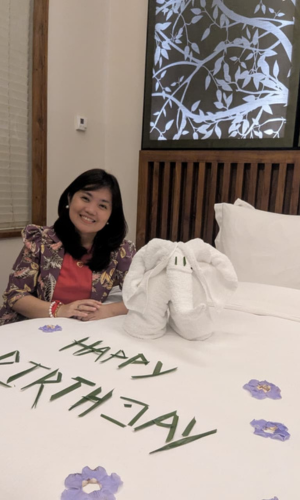
Forty-two is a strange age. You’re no longer young enough to blame everything on inexperience but not yet old enough to be forgiven for it either. I’ve lived enough life to see patterns in myself, in people, in how the world actually works versus how I was told it would.
These are things I learned the hard way, through bad decisions, broken relationships, some wasted years, and the occasional, humbling stroke of grace.

1. Be generous before you can afford to be.
Not everyone will agree with me on this and that’s okay. But the moment I started earning, I made a decision that my younger sister was going to finish high school and my brother in college was going to have an allowance. Christmas meant gifts for my grandparents even when my own budget was thin.
My 20s and 30s were largely spent giving to my family, to the people I loved, to the moments that mattered to them. There were probably “smarter” financial moves I could have made. But here’s what I know at 42, I did it when I felt the passion to give. That window doesn’t stay open forever.
Now I look back and I’m not depleted. I’m actually satisfied. Because I made them happy at a time when it counted. I believe generosity isn’t just a moral virtue. It’s a decision to act on love while you still can. I gave when it cost me something and I don’t regret it.
2. Don’t wait until something gets complicated.
Before you get overwhelmed, stressed, and frustrated, simplify, address, resolve. Tackle it right away. A small friction with a colleague, an argument with a sibling, a pile of papers, a broken door, a cluttered closet, a business process that’s outlived its purpose. I noticed many times that small things compound into heavy things. The cost of delay is almost always higher than the discomfort of doing it now.
For the last five years, my personal goal has been simple and that is no unwanted pressure. No unnecessary stress. If something is getting bigger than it needs to be, I either deal with it immediately or I cut it entirely.

I used to run three websites. I couldn’t attend to all of them properly and still blog consistently so I consolidated everything into one. I streamlined my freelance work by building out a set of ready-to-go templates: portfolio, cover letter, invoice, proposal. I don’t reinvent the wheel every time a new project comes in. And when 10,000 steps a day starts feeling like a burden instead of a habit, I do 5,000 instead and I do it without guilt.
Simplification is refusing to let the weight of the unmanageable crush the things that actually matter. Do less, better. Cut what you can’t carry. And do it before it becomes a crisis.

3. Don’t fret if you feel time was taken from you. God will bring it back.
I became a guardian to my siblings at a very young age. There was no ideal childhood waiting for me, no carefree teenage years full of play and laughter and the luxury of just being young. I had my first paying job at 18 and have been working ever since, part-time at first, then fully, then always.
For a long time, I grieved what I didn’t get to have. The lightness. The freedom. The years that other people seemed to move through so easily while I was already carrying weight that wasn’t mine to carry alone.
But now, in my 40s, something quietly shifted. I go to cafés whenever I want to…just because. I watch Netflix shows without guilt. I visit museums, walk through theme parks, sit in the middle of ordinary Tuesday pleasures that my younger self never had access to. I am, in the truest sense, learning to parent myself. To tend to my inner child with the gentleness she always deserved.
God is good. He makes up for the long, lonely days and nights, not always in the way you expect, and rarely on your timeline, but He does. The seasons you were robbed of don’t disappear. They come back around, quieter and sweeter than you imagined, when you’re finally ready to receive them.
Don’t rush the restoration. Trust that it’s coming.
4. Don’t get into other people’s karma. You can guide, but you cannot walk their path for them.
This one I learned the hard way.
The people you love, your siblings, your friends, the ones you’d do anything for, they have their own destiny to fulfil. Their own lessons to live through and these lessons will liberate them. Their own growth can only happen when they face their own challenges. When you step in too much, too often, too completely, you don’t protect them. You weaken them.
I know because I did it. I extended so much help to my siblings, absorbed so much of what should have been their responsibility, that I was quietly doing them a disservice. I was so busy carrying things for them that they never had to build the muscle to carry those things themselves. Thankfully, I caught it before it was too late. I stepped back. And slowly, they stood up.
Now they are independent. And I am lighter, free of burdens that were never truly mine to hold.
You can offer advice. You can open doors. You can love people fiercely and still let them stumble. In fact, sometimes the most loving thing you can do is let them stumble. Their karma is theirs. Their lessons are theirs. Your job is to be present and not to be a buffer between them and their own becoming.

5. Most career breakthroughs come from people and not plans.
I don’t burn bridges. It’s not just a policy and it’s something I believe in deeply, and I’ve lived proof of it more than once.
A former supervisor from when I was working abroad reached out years later with a freelance project designing materials. A former client referred me to someone who needed Pinterest management…completely out of the blue. A former colleague recommended me to teach at the college where she was working. None of these were in any five-year plan. None came from a strategy. They came from relationships I had taken care of long after there was any obvious reason to.
The world is smaller than it looks, and people remember more than you think, how you showed up, how you left, how you treated them when there was nothing to gain. As much as I can, I tend to those connections. Not transactionally. Not with an agenda. Just genuinely, because I know that one day, sometimes years later, a door opens that wouldn’t have existed if I’d let that relationship rot.
Your network isn’t a ladder. It’s a garden so tend it long before you need anything from it.

6. Leave. At least once. Go somewhere that has nothing to do with the life you already know.
One of the best decisions I ever made was to work abroad. I left the Philippines at 24 with no real script for what would happen next, just a job in Brunei and enough courage to get on the plane. I stayed for seven years.
I didn’t know that I’d meet my would-be husband there. I didn’t know that I’d eventually move to Sri Lanka, build a life there, and still be there a decade later. I didn’t know that in 2023 I’d do my first solo trip, just me, a backpack, a small suitcase and an itinerary I owned entirely.
None of it was planned. All of it shaped me.
The exposure to different cultures, different ways of living, different versions of what a normal life looks like has been one of my greatest educators. It taught me that the world is far less frightening than it looks from inside your hometown. It showed me that I was more capable than I gave myself credit for. And it quietly, steadily helped me understand myself in ways that staying put never could have.

You don’t have to move countries to get this. But you do have to go somewhere unfamiliar, stay long enough to feel uncomfortable, and let that discomfort do its work. The version of you that comes back or stays will be bigger than the one who left.
7. The most valuable career skill isn’t expertise, but it’s the ability to transition.
In my 4th year of university, BPO was rapidly emerging in the Philippines. I was studying to be a teacher, preparing for my licensure exam and I applied to a call centre anyway. The pay was good. It funded my life in Manila and put my sister through school. I didn’t wait to be fully ready. I moved.
Then teaching English abroad became more in demand, and I moved again. In 2013, conversations about virtual assistance and online ESL teaching started surfacing. I took note. By 2015, I had made the leap. Then came blogging. Solo travel. Social media marketing. And now there’s AI.
Looking back, there’s a clear pattern: I was always early. Always willing to try something when it was still new, still uncertain, still slightly uncomfortable. I didn’t wait for it to become obvious. I didn’t wait until everyone else was already there.
The skills that have served me most aren’t the ones I studied in school. They’re the ones I picked up at the edge of something emerging, curiosity, adaptability, the willingness to be a beginner again and again. Industries shift. Titles change. The people who survive and thrive are the ones who never get too attached to what they’re currently good at.
Stay teachable. Stay restless. And when something new is on the horizon, don’t wait for permission to walk toward it.

8. Live lightly. Hold nothing too tightly, not things, not people, not outcomes.
It took me a long time to get here. Years, actually. But I’m better at it now, and I can tell you without hesitation, it is one of the most freeing things I have ever learned to do.
I don’t attach. And I don’t let others attach to me out of obligation.
When I help my siblings or my friends, I make it a point to tell them, you don’t have to pay this back. Don’t feel obliged to be nice to me because of this. Don’t carry it. I’m not giving to create a deb, I’m giving because I want to and once it’s given, it’s gone. No strings. No scorekeeping. No silent expectation waiting to be disappointed.
I don’t expect anyone to remember my birthday. I don’t expect people to celebrate my wins, to check in on me, to ask how I’m doing. When they do, it’s a beautiful surprise. When they don’t, there’s nothing to grieve because there was nothing owed.
And emotions…I feel them fully, then I let them go. Something painful comes: I sit with it, I acknowledge it, and then I actively choose to snap out. Something joyful arrives, I receive it completely, I savour it, and then I release it too. I don’t cling to the good any more than I wallow in the bad.

I wish I could tell you that 42 years is enough to have it all worked out. It isn’t. The lessons above took time, pain, and a lot of humbling moments to land. But there are things still in motion, practices I’m building, mindsets I’m slowly rewiring, ways of living I’m reaching toward but haven’t fully arrived at.
I think that’s worth sharing too. Not just the hard-won wisdom, but the honest, unglamorous work still in progress.
Living with uncertainty.
I am not naturally comfortable with not knowing. I like plans. I like clarity. I like knowing what comes next. But life, as it turns out, is spectacularly indifferent to that preference.
When I was younger, anxiety came easily, about money, about success, about whether things would work out. I worried in the way young people do, convinced that the right amount of planning could keep the unpredictable at bay.
Then the world taught me otherwise in a quick and brutal succession.
The Easter Sunday bombings in Sri Lanka in 2019. The global pandemic that swallowed 2020 and 2021. The foreign reserves crisis and the fuel shortages that gripped Sri Lanka in 2022. Economic recession. AI reshaping entire industries overnight. Wars that remind you how fragile the ordinary is.
You cannot plan your way through any of that. You cannot anxiety your way to safety. At some point, the uncertainty stops being something you manage and starts being something you simply live inside of.
What I’ve come back to, again and again, is this: count on your abilities. Not the market, not the stability of any one country or industry or platform, but what you can do, what you know how to do, what you can learn. Live minimally, so that less is at stake when things shift. And exercise faith in God, in the quiet belief that you will be provided for even when you cannot see how.
I’m still practicing this. Some days the old anxiety creeps back. But I’ve lived through enough disruption now to know that I’ve come out the other side every single time. That counts for something. That, slowly, becomes its own kind of certainty.

Making decisions rooted in sustainability for my mind and my body.
I’m getting better at asking a different set of questions before I say yes to something: Is this sustainable? Will this cost me my peace? What does this look like for my mental well-being six months from now? What does it do to my body over time?
It sounds simple. It isn’t. Years of pushing through, of saying yes out of obligation or fear, of treating endurance as a virtue, those patterns don’t unlearn overnight. But I’m practicing. I’m making slower decisions. I’m choosing things I can actually keep choosing.
It shows up in how I choose clients now. I don’t just take any work that comes. I look for people who are aligned with how I work, who trust me, who don’t micromanage, who give me room to do what I’m good at without standing over my shoulder. A client who drains you costs more than they pay.
It shows up in the kind of projects I take on. I’ve moved away from big, sprawling engagements that consume months and bleed into every corner of my life. I want projects with a clear shape and a clean end, work that lets me close my laptop on a Friday and actually have a weekend. A weekend to watch Netflix, write a blog post, make content, walk at the park, or book a trip without guilt.
And it shows up in how I take care of my body. I want a routine I can actually maintain, one where I track my steps, my water, my food, my movement. Not obsessively. Just consciously. The way you’d tend to anything you want to last.
Sustainability, for me, is deciding, firmly and repeatedly, that the life around the work matters just as much as the work itself.
Refining what a rich life means to me and actually living it.
Not rich in the way the world usually means it.
I’ve been quietly building my own definition of this for years and it looks nothing like what I was taught to want. It has something better… PEACE.

A rich life, to me, means I hold no grudges. I have forgiven the people who hurt me, not because what they did was okay, but because I refused to carry it. I wish them well and I mean it. That lightness is wealth. That freedom is wealth.
A rich life means waking up and feeling genuinely glad to be alive. Excited, even. I get to create learning materials that I sell. I blog. I make content. I do client work that fits my life rather than consuming it. These aren’t just tasks on a list, but they are the shape of a day I actually designed.
It means following my fasting period. Monitoring my steps. Eating food that’s good for my body. Sleeping enough, really sleeping, not just collapsing. Not being addicted to anything. These sound small, but to me, they are the infrastructure of a life that works for me.
It means watching the sunset. Having tea. Having coffee. Sitting with Netflix on a quiet evening and feeling zero guilt about it because the work is done and the day was good.
It means my health is okay. Not perfect, but okay. And okay, right now, feels like everything.
I used to think a rich life was something you arrived at. Now I think it’s more like a frequency you tune yourself to, by removing what doesn’t belong and saying yes, again and again, to the things that make you feel most like yourself.
I’m still refining it. But more and more, I look at my days and think, this is it. This is the life. And I am so grateful it’s mine.

At 42, I’m still wrong about things. Still inconsistent. Still figuring it out. The difference is I’ve stopped pretending I’m not.
That, perhaps, is the real lesson under all the others.
If something here stayed with you, I’d love to know which one. Drop it in the comments or if you’re in your 40s too, tell me a lesson that changed you. We’re all still figuring this out together.
(We write our content in the hope of making you, our readers, feel a little more inspired in a time when you’re probably feeling low. We hope you feel a little lighter after visiting our site. Then, we know we’ve served our purpose.⭐)
🍀 Let’s Stay Connected!
If this post resonated with you, let’s keep in touch. I share more on:
- ✈️ Travel, cozy cafes, food discoveries, and freelance life on Instagram and Facebook
- 🧠 Mindful productivity, instructional design, and digital business on LinkedIn
- 💻 Plus, I regularly share digital products and courses to support freelancers, educators, and startups on all three platforms.
Let’s connect. I’d love to learn about your journey too!
