

Thank you for patiently waiting for Part 1!
Term 3 classes have started and things have gotten a little busier on my end, so it took me a bit longer to put this together. Honestly, it’s so hard to write when you want something to be actionable and practical to the reader. But here it is!
This time, we’re talking about one of the most important parts of your JET Programme application. It is your Statement of Purpose (SOP).
I want to share with you how I approached writing mine, from planning and brainstorming, to drafting, revising, and editing. But more than just showing you what I wrote, I want to share the mindsets and strategies I used while writing it.
I’ll also be sharing my actual SOP as a guide. I want you to see how certain ideas can be translated into actual sentences and paragraphs. As we go through my SOP, I’ll point out specific lines and sections and explain what mindset or strategy I used and why I made certain writing choices.
I believe that a strong Statement of Purpose should help the people reading your application understand who you are, what has shaped you, what you can bring to the JET Programme, and why JET makes sense as the next part of your story.
So, rather than giving you a formula to copy, I want to walk you through how I thought about my own story and turned it into an SOP. Use my SOP as a guide. Borrow the strategies, not the sentences. And most importantly, make sure that when you’re finished, your SOP still sounds like you.
Let’s start with what I did before writing a single sentence.
Start with the Right Mindset
Before you start writing your SOP, let’s talk about mindset. And please, DON’T skip this part.
I know the temptation. You probably want to get straight to the good stuff like What should I write? What should my first paragraph be? What keywords should I use? How do I make my SOP stand out?
But before you start putting sentences together, I want you to pause.
The way you think about your SOP will influence the way you write it.
When I wrote mine, I carried a few mindsets with me throughout the entire process. These helped me decide what to include, what to leave out, how to tell my stories, and how to connect my experiences to my reasons for applying.
So before we get into my actual SOP, here are the mindsets I want you to adopt, or at least consider, before you write yours.
Think of these as the thinking tools behind the writing.
Let’s begin.
Mindset # 1 – Write for One Person Only
When I first started writing my SOP, I actually imagined a group of people reading it. The instructions said JET Screening Committee, so naturally, I pictured a committee sitting somewhere, reading my SOP and evaluating me.
But as I started writing, I noticed something happening. I kept correcting myself. I would write something, read it again, and think, “Does this sound impressive enough?” or “Is this what they want to hear?”
I became too conscious of how I was presenting myself. And the more I tried to sound impressive, professional, and correct, the less genuine my writing felt to me. It felt like I was trying to perform for a group of people I couldn’t even see.
So I changed the person I was imagining.
A human being.
Yes, that person might be part of a screening committee. He or she might be sitting at a desk, reading application after application. And I imagined that somewhere in that stack of applications, mine would eventually reach his or her hands.
I didn’t know who that person was.
But I could imagine one thing, I wanted my writing to make this ONE person pause. I wanted him or her to pause because something I wrote felt genuine, interesting, or worth remembering.
And once I had that person in mind, I could write more naturally. I could explain why an experience mattered to me. I could talk about what I learned from it. I could connect my experiences to my reasons for applying.
I still wanted my SOP to be professional, organised, and appropriate for a formal application. But I stopped trying so hard to sound impressive. I focused more on being clear, honest, and genuine.
So when you write your SOP, try this mental shift. Don’t write for the institution. Don’t write for some abstract idea of “the JET Programme.”
Write for the human being on the other side of the page.
I kept on thinking, “If I were telling my story to one professional person, what would I want them to understand about me?”
And that became the mindset I carried throughout the rest of my writing.
Now let me show you how this mindset appeared in my actual SOP.
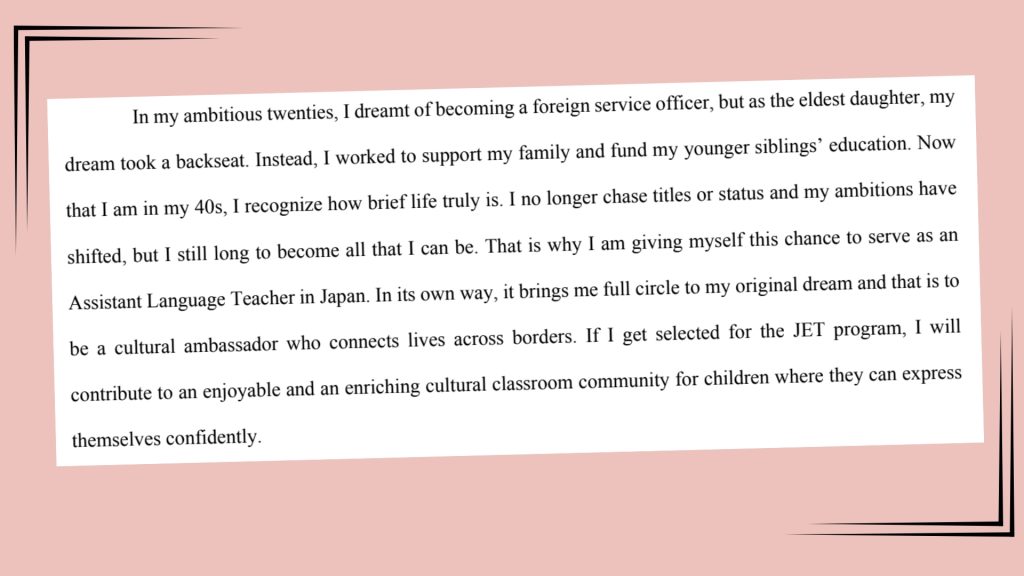
The image above is a paragraph taken from my SOP that went through six or seven versions before I was finally happy with it. I kept writing it, changing it, deleting parts, and starting again.
Looking back, I think I know why. I was worried about being misjudged. There was a part of my story that I felt I had to explain carefully. I had finished my degree in teaching. I had passed my licensure exam. At one point, I even had a dream of becoming a Foreign Service Officer. And then… I didn’t pursue it. Instead, I ended up working for a BPO company.
The simple truth was that I needed the money. As the eldest daughter in my family, I had responsibilities, and at that point in my life, earning an income was more urgent than following the career path I had originally imagined for myself.
But when I imagined a committee reading that story, I became worried about what they might think.
Would they think I wasn’t serious about teaching? Would they think I had wasted my degree? Would they question why I had taken a completely different path?
So I found myself trying too hard to explain and justify my choices. And ironically, the more I tried to make myself look good, the more defensive my writing sounded.
Then I went back to the mindset I had adopted. One professional friend.
I imagined sitting across from someone who simply wanted to understand my journey. I didn’t have to convince him or her that every decision I had made was perfect. I just had to explain what happened. And suddenly, the words came much more easily. I could tell the story without apologizing for it. I could acknowledge that my career path wasn’t a straight line without making it sound like something I needed to defend.
And that was when the paragraph finally started to sound like me. I wrote it from the perspective of “How do I make the committee think I’m impressive?” to “If I were telling this part of my story to one professional person, how would I explain it honestly and confidently?”
And this brings me to the second mindset.
Mindset # 2: There’s Strength Behind Your Story
This became especially important for me when I was writing about parts of my journey that I initially thought could put me at a disadvantage, just like what I shared in the first mindset section.
Instead of asking:
“How do I hide this weakness?”
I started asking:
“What strength is actually behind this part of my story?”
In my case, my decision to work in a BPO company wasn’t because I had stopped caring about my career or because I had no direction. There was a reality behind that decision. I had family responsibilities as the eldest daughter. I needed to earn. I made a practical choice based on the circumstances I was in at that time.
And that experience became part of the person I eventually brought into the classroom.
Another thing that I became very conscious of when I was writing my SOP was my age. I was already in my 40s.
I had a Master’s degree. I had years of teaching experience. I had already worked internationally. I had established myself professionally. And suddenly, I was applying to become an ALT.
I could almost hear the questions.
“Why?”
Why would someone at this stage of her career want to become an ALT? Why Japan? Why now? Would they think I was overqualified? Would they think I was simply looking for an opportunity to leave my current situation? Would they wonder whether I would actually be happy doing this work?
Something that I considered a strength, my education, experience, and established career, could also become a question mark in the context of my application. And that made me realise something important. Your strengths don’t automatically speak for themselves.
Sometimes, you need to explain the story behind them. I had to understand my own why before I could communicate it convincingly to someone else.
This is why one of the ideas I kept coming back to while writing my SOP was this. My story is my strategy.
Even when I felt that I was coming from a disadvantage, I could still use my story to communicate something about who I was, what I had learned, and what I could bring with me. I didn’t need to pretend that every part of my journey was perfect. I needed to understand what that journey had given me.
And this is something I really want you to explore in your own SOP.
Maybe you have a career gap. Maybe you changed courses. Maybe you didn’t immediately work in the field you studied. Maybe you don’t have the kind of international experience you think other applicants have. Maybe you think a particular part of your background makes you less qualified.
Before you decide that something is a weakness, look at the story behind it.
What did that experience teach you? What did you have to overcome? What responsibilities did you carry? What skills did you develop because of it? What perspective did you gain? What does that experience allow you to understand today that you might not have understood otherwise?
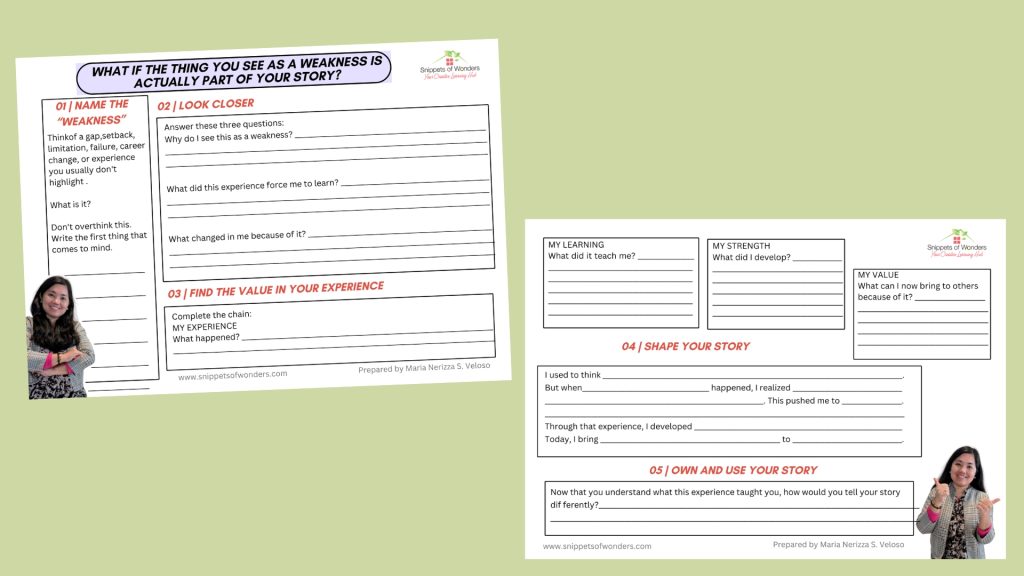
That is where your story can become a strategy. In fact, this idea became the basis for a worksheet I created called The Story Behind Your Strength.
I made it to help you look at the experiences you might be tempted to hide or minimise and dig deeper into the story behind them.
You can download the worksheet here.
I recommend doing this before you start writing your SOP.
What I realised is that the strongest parts of your SOP aren’t found in the things you are most proud of, but hidden inside the parts of your story you were initially afraid someone might judge. And once you understand that, you can start turning your story into your strategy!
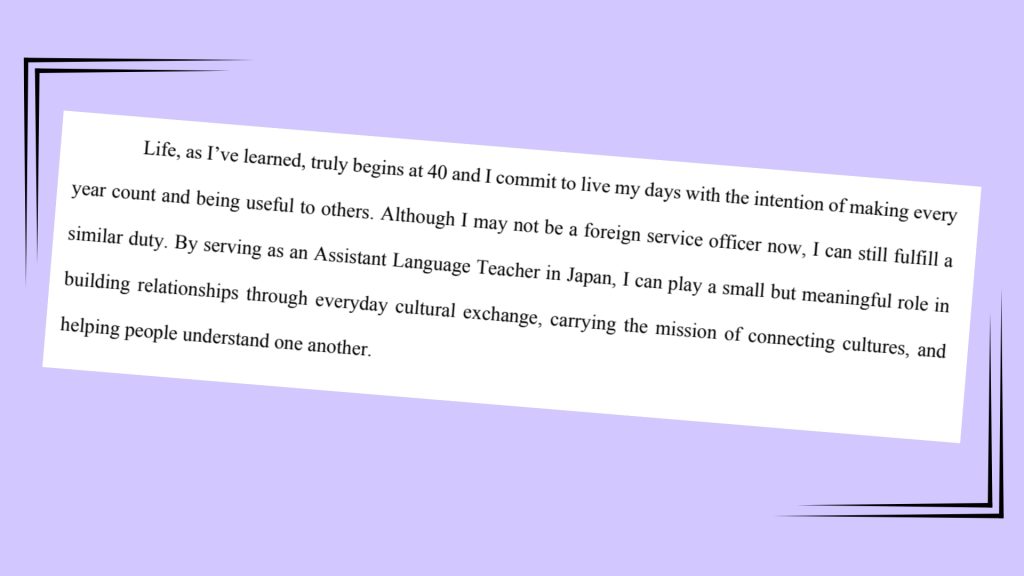
I couldn’t change the fact that I was in my 40s, had a Master’s degree, had years of professional experience, and had already built a career. And I realised, I didn’t need to. So, instead of feeling ashamed or defensive about my age, I decided to own it.
Instead of asking myself, “How do I make them overlook my age and experience?”, I asked, “How can I make them understand why these experiences make sense for JET?”
That changed the way I positioned myself in my SOP.
I stopped focusing so much on myself simply becoming an ALT.
I started thinking about the bigger role I could play as someone who could contribute to the JET Programme’s mission of international exchange and cultural understanding.
My age and experience weren’t things I needed to apologize for. They were part of what I could bring to the role.
Look closely at the 2 screenshots above (ones in pink and purple). These are the parts of my SOP where I applied that mindset.
Notice how I didn’t write, “I’m already in my 40s, but…” or try to convince the reader that my age shouldn’t matter.
In the body of my SOP, I gave concrete and specific examples of how my age with all of the wisdom from it would serve the purpose of my application and I’ll show you this when we move to the next mindset which is on being specific and concrete.
And this brings me to the next mindset.
Mindset # 3: You Appear More Credible with Being Specific and Concrete
Specificity and concreteness is how you prove the story about yourself. Once I decided that my age and experience were not things I wanted to apologize for, I knew I had to show the reader of my SOP why they mattered.
I couldn’t simply say, “I have a lot of experience.”
Or:
“I can contribute a lot to JET.”
Those statements don’t really tell the reader anything. So instead, I started asking myself, “What specifically can I bring?”
And I made sure my SOP contained concrete examples.
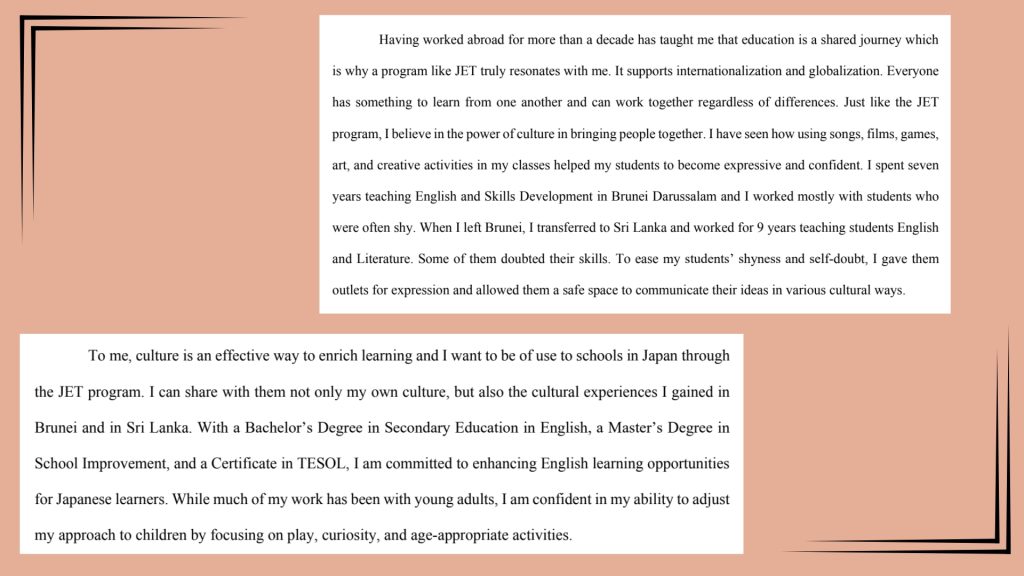
For example, I didn’t just talk about my experience. I shared what I had actually done in my previous two jobs.
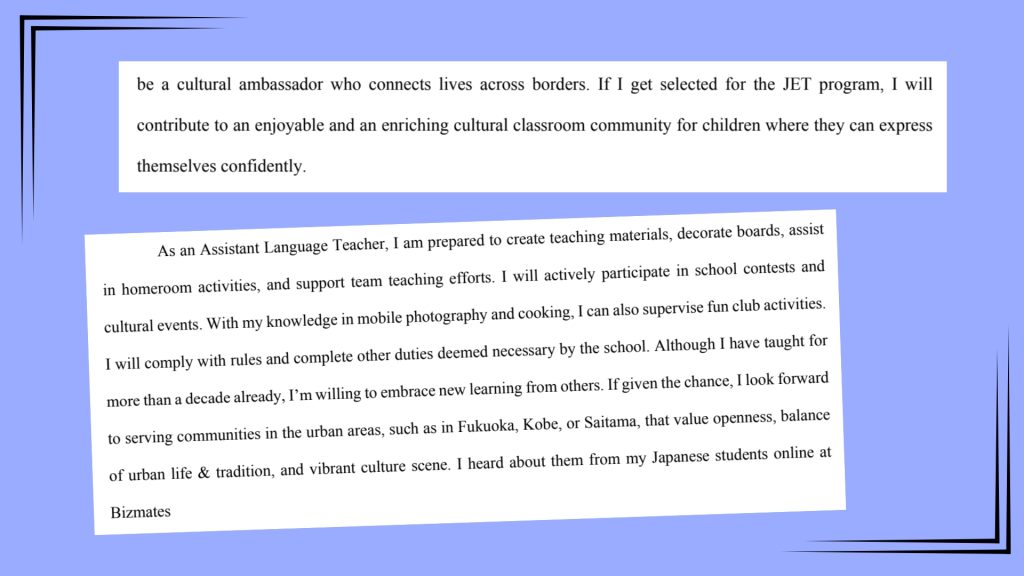
I shared the things I planned to do if I were selected and talked about the responsibilities I was willing to take on as an ALT.
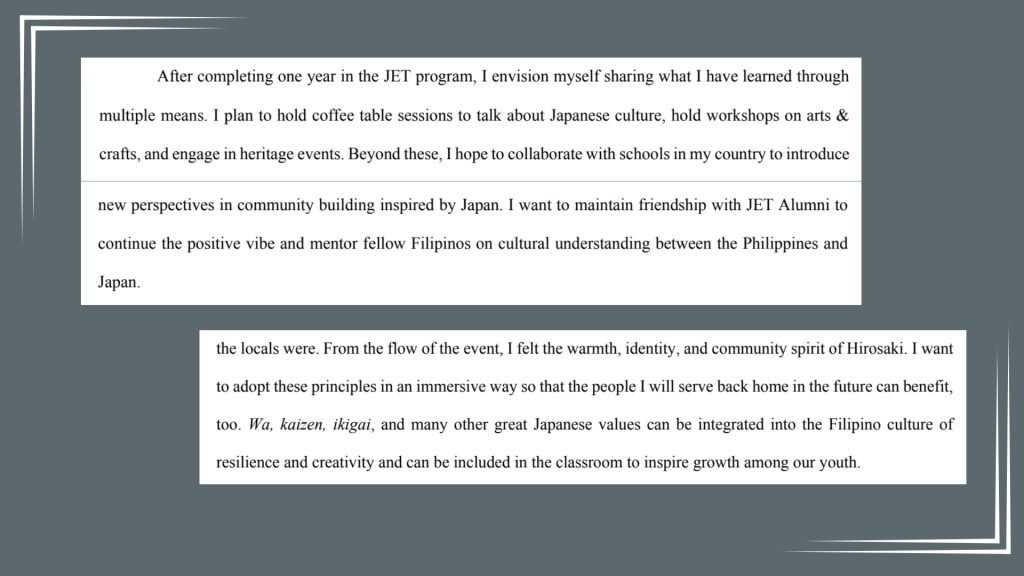
I also talked about my concrete plans for after completing JET.
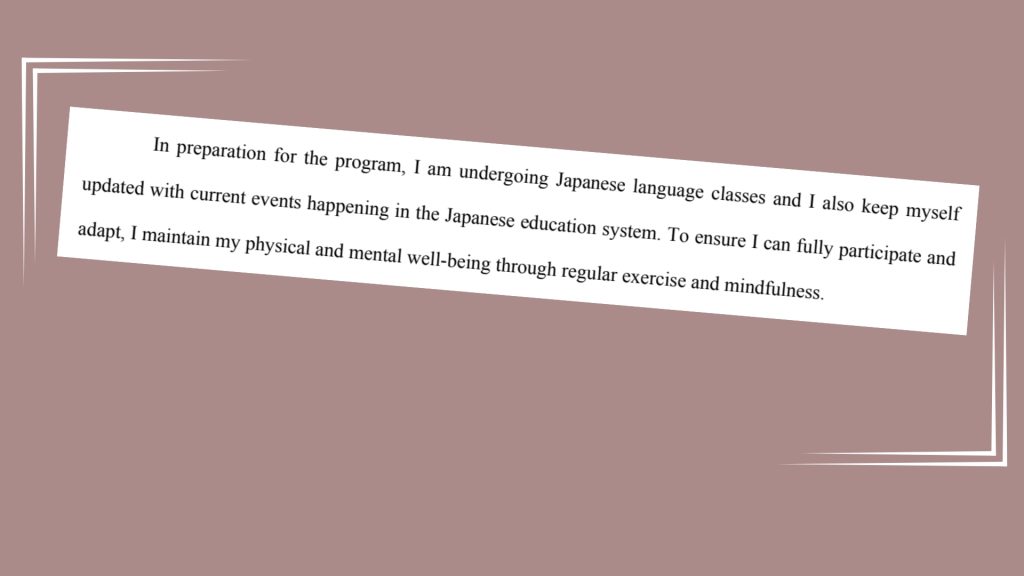
I even talked about what I was already doing to prepare for JET.
Sharing all of these was particularly important for me because of my age and professional background. I knew someone could look at my application and wonder, “Why would someone in her 40s, with a Master’s degree and years of professional experience, want to become an ALT?”
Instead of trying to avoid that question, I wanted my SOP to answer it through the specifics of my plans, experiences, and intentions. I wanted the reader to see that I hadn’t simply decided, “I want to go to Japan.”
There was thought behind the decision. There was preparation behind it. There was a reason for doing it at this particular stage of my life. And there was a plan for what I hoped to do with the experience.
Don’t Just Tell Them. Show Them.
This is something I want you to remember when you write your own SOP: Don’t just tell the reader who you are. Give them evidence.
Instead of, “I am passionate about cultural exchange.”
Ask yourself, “What have I actually done that demonstrates this?”
Instead of, “I will contribute to my community.”
Ask, “What specifically do I plan to do?”
Instead of, “My previous work has prepared me for JET.”
Ask, “What did I actually do in that work and how is it relevant?”
Instead of, “JET will help me achieve my career goals.”
Ask, “What exactly do I plan to do with what I learn from the experience?
Specificity makes your story easier to believe because you’re giving the reader something they can actually see.
And when I look back at my own SOP, I can see that this was one of the things that helped me move away from simply trying to convince the reader that I was qualified.
I was giving them evidence of why my experiences, my plans, and my timing made sense.
Now, let’s move forward to the next mindset.
Mindset # 4: Answer the Question Behind the Question
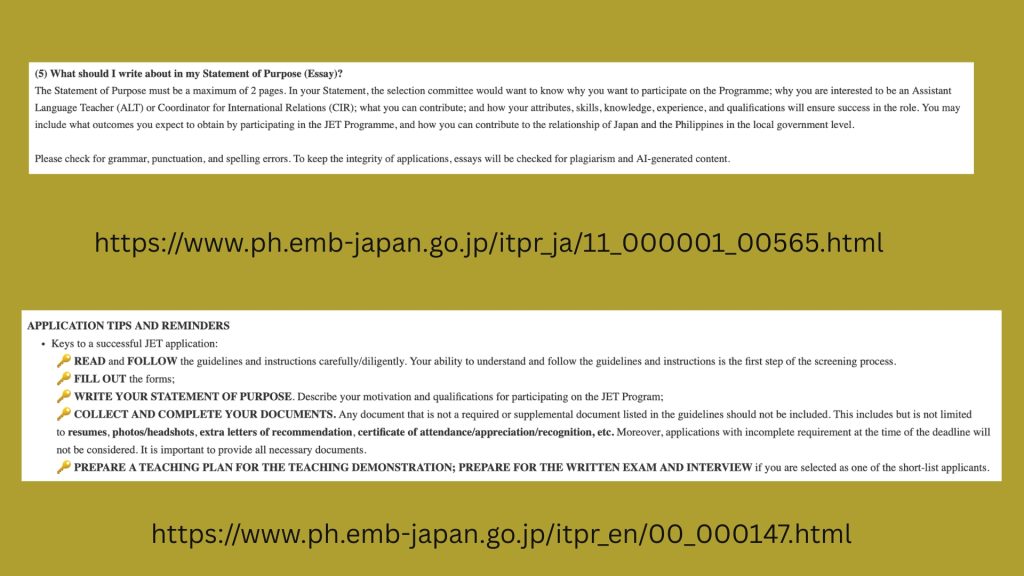
Referring to the previous guidelines, last year’s one to be specific, the JET Programme asks these questions in the Statement of Purpose.
- Why you want to participate on the Programme
- Why you are interested to be an Assistant Language Teacher (ALT)
- What you can contribute?
- How your attributes, skills, knowledge, experience, and qualifications will ensure success in the role?
- What outcomes you expect to obtain by participating in the JET Programme?
- How you can contribute to the relationship of Japan and the Philippines in the local government level?
When you look at my SOP (it’s shared below for reference), you will see that I have answered all of these questions. But let me emphasize that when I was writing my SOP, I also thought about the questions underneath them. For example:
Will this person take the opportunity seriously? Will this person be able to contribute meaningfully to Japanese schools and communities? What does this person bring to the exchange that students and the community can learn from? Why does this particular person’s background make sense for JET?
It’s very easy to answer the questions entirely from your own perspective like I want to experience Japan. I want to learn Japanese. I want to grow as a teacher. I want to experience a different culture.
All of those can be genuine reasons for applying and you should absolutely talk about your own motivations.
But with the research I gathered from former ALTs, I found out that JET isn’t only about what you want to get from the experience. It’s also about what you bring into it. And that’s the shift I tried to make in my own SOP.
For every important statement about what I hoped to gain from JET, I tried to think about what I could give in return. I understood that if I was asking to become part of this programme, I also needed to show that I understood my responsibility within it.
For example, I want to grow as an educator. How will that growth benefit the students I work with?
I want to learn more about Japanese culture. How can my genuine curiosity contribute to meaningful cultural exchange?
I want to experience life in Japan. What experiences, perspectives, and cultural knowledge will I bring with me to share with Japanese students and the community?
My growth as an educator can mean better lessons for my students. My curiosity about Japan can become genuine curiosity that students can see, respond to, and participate in.
My international experiences can become perspectives that I can share with students and colleagues. And my desire to learn from Japan can exist alongside my ability to share something of my own culture and experiences.
That is what I tried to hold together in my SOP. What I want from JET and what I can give to JET.
I think my SOP became much stronger when I showed how my own growth and the benefit I can bring to others are connected.
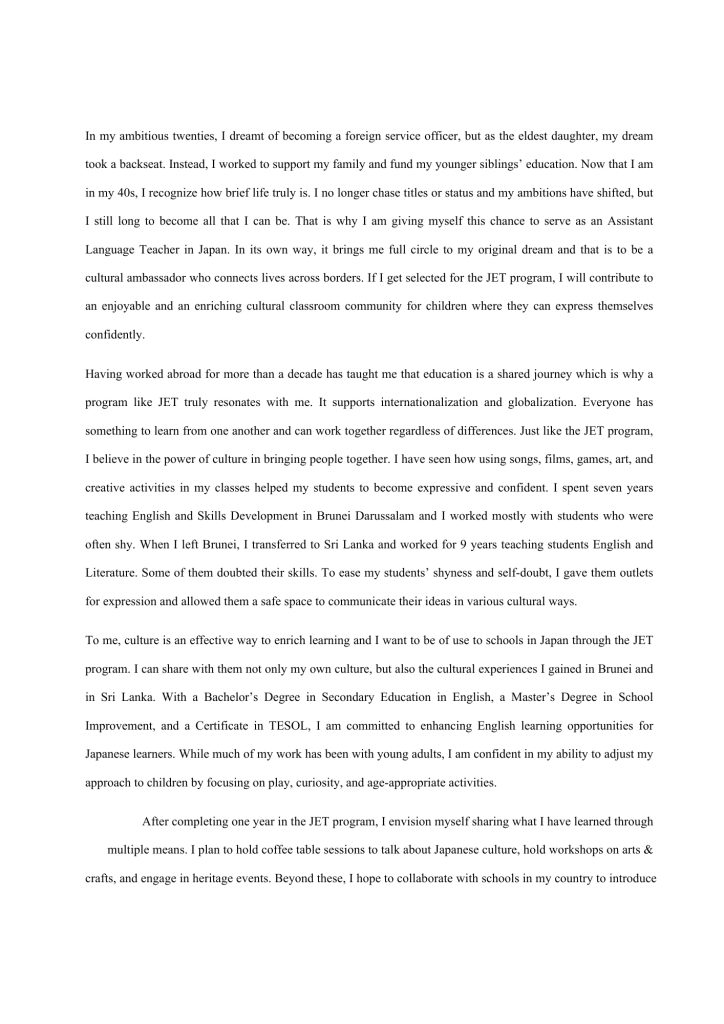
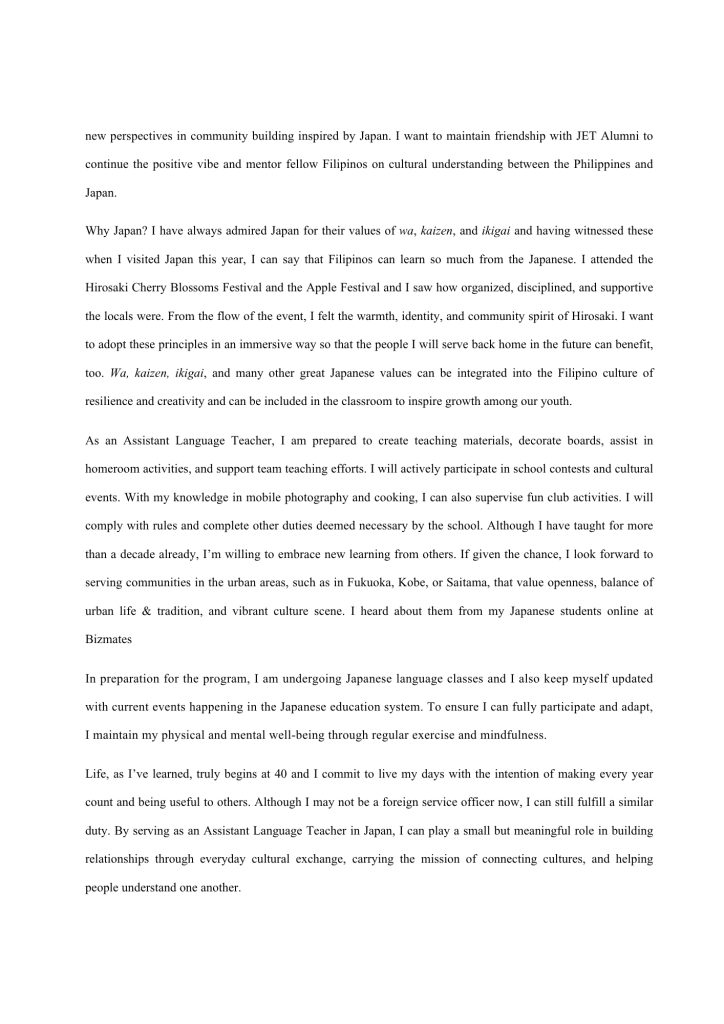
But mindset alone isn’t enough. I also used some very intentional writing strategies, especially because the JET SOP has a strict space limitation. Here are the strategies I used when I actually sat down to write, revise, and edit.
Use Intentional Writing Strategies
Strategy # 1 : Blow your own horn.
This one might sound a little uncomfortable, especially if you’re not used to talking about yourself. But I deliberately told myself, “Blow your own horn.”
I didn’t assume that the reader would automatically recognise the value of my experiences.
He or she doesn’t have my resume sitting beside him/her while I explain my life story. I had to tell him / her.
I had taught in different countries so I needed to say what that experience had taught me.
I had done something that demonstrated my ability to contribute, I couldn’t simply hope that the reader would connect the dots. I had to connect them for him/her.
This is not the time to be overly humble.
Tell your story confidently, but just make sure you can back it up. Don’t be afraid to show your accomplishments, experiences, skills, and perspectives.
Strategy # 2 : Every sentence has to earn its place.
I had two pages maximum. That meant every sentence had to work.
I couldn’t afford sentences that were simply there because they sounded nice.
During my revisions, I constantly asked myself:
Does this sentence need to be here? Does it tell the reader something important about me? Does it move my story forward? Does it provide evidence? Does it explain my motivation? Does it show what I can contribute? Does it connect one idea to another?
If the answer was no, I considered cutting it.
This was probably one of the hardest parts of editing because sometimes I really like a sentence, but liking a sentence isn’t enough.
It has to earn its place. And sometimes, one well-chosen sentence can do the work of three.
Let me show you what I mean by “every sentence has to earn its place.”
There was one section of my SOP that originally took up two paragraphs.
It was answering an important question, Why Japan?

I had a story I really wanted to tell about something I experienced in Hirosaki. I wanted to describe what I saw, what struck me about the experience, and why it mattered to me. But I didn’t want to stop there.
I also wanted to explain how I hoped to take what I learned from that experience and apply it to my own country when I returned home after completing the JET Programme. And honestly, I had so much more I wanted to say.
I wanted to explain the experience in greater detail. I wanted to talk more about what I observed. I wanted to explain my ideas about bringing some of what I learned back home.
But then I looked at my SOP. Two pages. And my ideas were taking up too much space.
So I had to make a difficult decision. I cut it down.
Those two paragraphs eventually became one paragraph. And yes, there were things I had to leave out that I really wanted to keep.
But this is where I had to remind myself of Strategy #2.
Strategy # 3: Put what matters most on the first page.
With only two pages, I also had to think strategically about where I placed information. I didn’t want to save my strongest points for the end. I wanted the reader to encounter the most important things about me early.
Think about it this way. If the reader only remembers a few things about you after reading your SOP, what do you want those things to be? Those ideas shouldn’t be buried somewhere in the second page.
I wanted my first page to establish who I was, what had shaped me, why JET made sense for me, and what I could potentially bring to the programme.
The second page could then develop and reinforce those ideas.
So when you’re outlining your SOP, don’t simply write everything in chronological order and hope the important parts naturally rise to the top. Decide what matters most and put it where the reader will see it.
Strategy #4: Don’t try to prove that you deserve JET.
I didn’t want my SOP to read like, “Here are all the reasons I deserve to be selected.”
Instead, I wanted the reader to come away thinking, “Now I understand who this person is, what she has experienced, what she can bring, and what she could become through this programme.”
I wasn’t trying to build a courtroom case for why I deserved a spot. I was trying to introduce myself. I wanted to show who I was at that point in my life, what had shaped me, what I could contribute, and how participating in JET could become part of my continued growth.
In other words, I wasn’t only writing about who I had already become. I was also showing who I could become through the experience.
And I think that is an important distinction when you’re writing your own SOP. You don’t have to convince the reader that you are already the perfect JET participant. Instead, show them who you are, what you bring, why JET makes sense for you, and what you could become because of the experience.
That is the story I wanted my SOP to tell.
Now, Let’s Get into the Process
We’ve talked about the mindsets I adopted and the strategies I used while writing. Now let’s get practical. What did I actually do?
Planning
I started with a mind map.
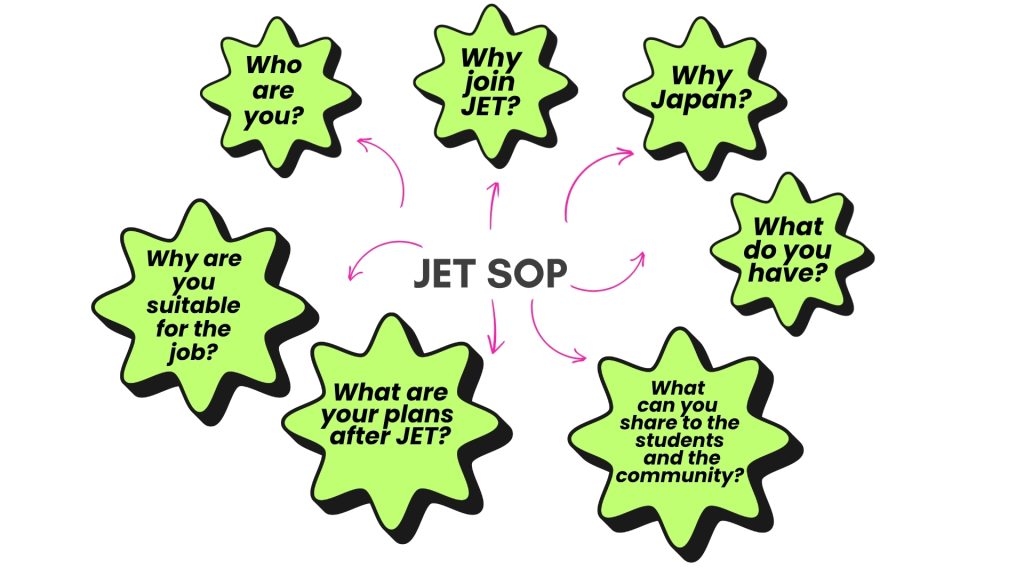
I wouldn’t recommend opening a blank Word document and forcing yourself to come up with the perfect opening paragraph.
Start messy. Brain dump. List your experiences. Write down your motivations. Think about your future plans. Think about what you can contribute. Think about the stories that shaped you. Get everything out first.
Then, start making decisions about what stays and what has to go.
I wanted to see the bigger picture before deciding which parts belonged in my two-page SOP. This was especially helpful because I had quite a lot of experiences to draw from. If I had started writing immediately, I probably would have ended up trying to squeeze everything into the SOP.
The mind map allowed me to first ask, “What do I have?” Then I could move on to, “What actually matters?”
And eventually, “What deserves a place in my SOP?”
Drafting
I already had my ideas from the mind map. Now I needed to turn those ideas into actual paragraphs and see how they worked together.
If I thought of another idea, I let myself write it down. If I wasn’t sure whether something would make the final version, I kept it for the moment. I had multiple versions of my draft!
So my goal during the first draft was simply to get the ideas down. Get the story moving. Don’t worry about perfection yet.
And remember the first mindset I talked about? I was writing for one person.
Once I shifted from imagining a whole screening committee to imagining one professional reader, drafting became much easier for me. I could explain an experience without overthinking whether it sounded impressive enough. I could talk about my motivations more naturally.
So even while drafting, I kept coming back to that imaginary reader. And that helped me get the ideas onto the page first. The polishing came later.
Revising
After I had my first draft, I moved on to revising. This was probably where I did the most thinking. It meant stepping back. I read through my draft again and again. I looked at the paragraphs. I looked at the transitions. I looked at the stories I had chosen. And I started asking questions like:
- Does this actually answer the JET prompts?
- Is this experience important enough to keep?
- Am I explaining too much?
- Is there a stronger example I could use?
- Does this paragraph tell the reader something meaningful about me?
- Am I showing what I can contribute, or am I only talking about what I want?
- Does this sound like me?
- If I only have two pages, is this sentence earning its place?
This was also when I became much more ruthless about cutting. Remember the example I mentioned earlier where two paragraphs eventually became one? This is where that happened.
I had to let go of things I liked because they weren’t essential to the story I was trying to tell.
During revision, I kept returning to the mindsets I talked about earlier. Am I writing for one person? If a paragraph sounded like I was trying too hard to impress a committee, I reconsidered it.
If I sounded defensive about a particular part of my background, I looked at it again.
Am I being specific? If I made a broad statement about my skills or experiences, I asked myself whether I could give the reader something concrete instead.
If I talked about what I wanted from JET, I asked myself what I could bring in return.
I wouldn’t rush this stage, so you can let your first draft sit for a while if you can. Then come back to it with fresh eyes. In my case, I would draft and then come back to it after a week and then revise.
And then comes Editing
Once I was happy with the content, structure, and story, I could finally move into editing. This is where I worked on wording, sentence structure, grammar, transitions, repetition, and overall flow.
Here are some of the things I looked for when editing my SOP.
1. Replace vague statements with concrete ones.
Watch out for words like passionate, dedicated, hardworking, adaptable, open–minded, culturally aware.
There’s nothing wrong with these words, but they don’t tell the reader much by themselves.
Instead of saying, “I am adaptable.” Show them a situation where you had to adapt.
2. Read it out loud.
I highly recommend this. You’ll hear when a sentence is too long. You’ll notice when something sounds unnatural.
You’ll catch repetition. And you’ll hear whether the writing actually sounds like you.
Remember my first mindset? I was writing for one person.
Reading aloud helped me check whether I still sounded like the person having that conversation or whether I had suddenly started sounding like an overly formal application essay.
3. Check paragraphs against the overall story.
After editing individual sentences, zoom out. Read the SOP from beginning to end.
Does it feel like one connected story? Or does it feel like a collection of things you wanted the committee to know?
I wanted my SOP to have a sense of direction. One paragraph should lead naturally into the next.
My reader should finish the SOP with a clearer understanding of who I am, what shaped me, why JET, what I can bring, and where this experience could take me.
4. Check the technical details.
Only after the content was where I wanted it did I worry about the smaller things:
- Grammar
- Spelling
- Punctuation
- Sentence structure
- Consistent tense
- Formatting
- Word count
- Page limit
- Font and spacing requirements
Of course, these things matter.
Parting Words
I know this was quite a long post, so if you’ve made it all the way here, thank you for sticking it out until the end!
I hope that somewhere along the way, you found something that made you pause and think differently about your own story.
The mindsets, strategies, and process I shared here are not only useful for writing a JET Programme Statement of Purpose. You can also apply them when writing a Statement of Purpose for graduate studies, scholarships, grants, internships, fellowships, or even other professional opportunities.
At the end of the day, the goal is the same and that is to understand your story, recognise the value in your experiences, and communicate them in a way that helps someone else understand who you are and what you can bring.
So feel free to take what is useful from this post and adapt it to whatever application you are working on. And if you’re currently writing your JET SOP, I hope my experience gives you a starting point, not something to copy, but a way to think about your own story.
And that’s a wrap!
Watch out for the next part of this JET application series!
And if you haven’t read the introduction to this series yet, you can start there first. I’ll link it below so you can follow the journey from the beginning.
Read How to Apply for the JET Programme as a Filipino.
(We write our content in the hope of making you, our readers, feel a little more inspired in a time when you’re probably feeling low. We hope you feel a little lighter after visiting our site. Then, we know we’ve served our purpose.⭐)
🍀 Let’s Stay Connected
If this post resonated with you, let’s keep in touch. I share more on:
